Deponia Beginner Guide
Which Deponia game to start with, which edition to buy, what to do when a puzzle stops you, and which achievements you can lose by moving on.
Deponia is four point-and-click adventures released between 2012 and 2016 by Daedalic Entertainment. They follow one character, Rufus, across one continuous story, so the order you play them in matters more than it does in most series. This page covers the three decisions a new player actually has to make — where to start, which edition to buy, and what to do when a puzzle stops you — and then lists the achievements you can permanently lose by moving on too quickly.
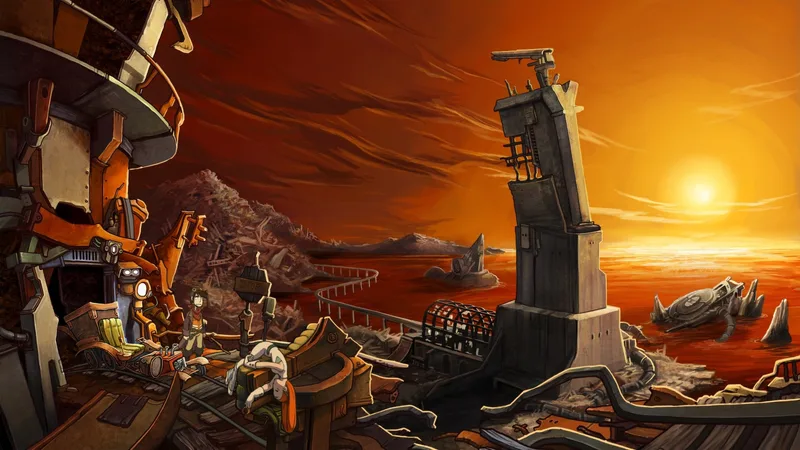
Start with the first game, in release order
Release order is story order. Play Deponia (2012), then Chaos on Deponia (2012), then Goodbye Deponia (2013), then Deponia Doomsday (2016). Each game opens on the situation the previous one ended in and assumes you know who everyone is, so starting in the middle costs you most of the jokes and all of the emotional payoff.
Doomsday is the one that trips people up. It came out three years after the trilogy finished and it is a time-travel story, which makes it look like a reboot you could start from. It is not — it is an epilogue built entirely on the ending of Goodbye Deponia, and playing it first spoils that ending in the first twenty minutes.
If you only ever play one, play the first. It is the shortest of the four, it has the fewest achievements (19, against 50 in Goodbye Deponia), and it ends at a natural stopping point.
Standalone games or The Complete Journey?
Deponia: The Complete Journey (2014) bundles the first three games and adds material the standalone versions do not have: over four hours of developer commentary, a world map that lets you jump to any chapter, a graphical questlog help system, help screens for the minigames, new hidden collectables, six new songs written and performed by Poki, behind-the-scenes videos, and Linux support.
The catch is in Daedalic's own store description: The Complete Journey does not include Deponia Doomsday. Buying the collection expecting all four games is the single most common mistake with this series. If you want the whole story you need the collection plus Doomsday, or the four standalone games.
The Complete Journey also keeps its own separate achievement list — 105 of them. Of those, 102 mirror achievements from the standalone games, and only three are exclusive to the collection: Story Time, Junkyard King and Journey Completed. Playing through the collection does not unlock anything on the standalone games' lists, so achievement hunters who already own the originals are starting from zero again.
What kind of game this is
These are traditional adventure games. You walk Rufus around hand-drawn scenes, pick objects up, combine them in the inventory and use them on the world. There is no combat, no timer on most scenes, and no way to make the game unwinnable — if a puzzle is not solving, the piece you need is somewhere you have not looked yet rather than something you destroyed an hour ago.
The comedy runs on absurd logic, and so do the puzzles. Solutions are usually reasonable for Deponia, not for the real world: you will glue things to other things, feed things to animals, and impersonate people using props that should not fool anyone. When a puzzle feels unfair, it is often because the logical answer and the funny answer are different, and the game wants the funny one.
Critics rated the series steadily upward as it went: Metacritic has the first game at 74, Chaos on Deponia at 78, Goodbye Deponia at 80 and Doomsday at 76. Steam files all four under Adventure and Indie. All four run on Windows, macOS and Linux; only the unreleased spin-off Surviving Deponia is Windows-only so far.
When you get stuck
Three habits solve most of it. Re-examine everything in the room, including scenery — Deponia hides required objects in background detail more than most adventures. Combine inventory items with each other, not just with the world. And exhaust dialogue: characters hand out both hints and physical objects only after you have run out their conversation topics.
If that fails, the walkthrough is split by flow section rather than by chapter number, because the games never print a chapter number on screen. For the first game those sections are the tutorial, Kuvaq, the Junk Mine, and the Lower Ascension Station.
The first game's reliable stopping points are worth knowing in advance, because they are where most players lose an evening: packing the suitcase and preparing the escape pod in Kuvaq, assembling the espresso from separate powder and water ingredients aboard the Organon cruiser, getting the mine cart running and then moving the unconscious Goal onto it in the Junk Mine, and clearing the mosaic table at the Lower Ascension Station. Each of those is a multi-object chain rather than a single click, which is why they stall people who are hunting for one missing item.
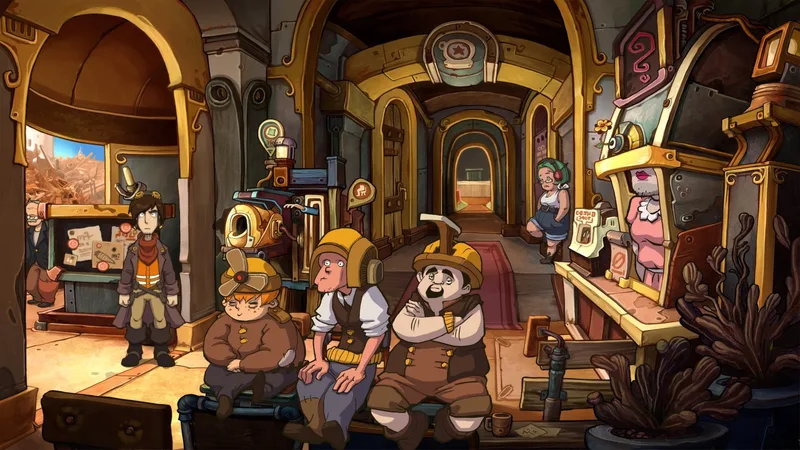
Achievements you can lose
Some achievements are tied to a single scene and close off when that scene does. Global unlock rates from Steam make the pattern obvious: in the first game, Kindergarten — awarded for the opening steps — sits at 73.9%, while Droggeljug is at 5.2%. That gap is not difficulty. It is players walking past a one-time interaction.
Across the four games, 11 achievements sit under 8% and 54 sit under 20%. Almost all of them are optional interactions in scenes you can leave. If you care about the list, check the achievements page for the game you are on before you finish a section, rather than after.
The first game shows the whole range in 19 entries. Kindergarten and Brushhunter (63.2%) come from actions the plot forces on you. Stand-In Waiter (37.3%) and Master Of Switches (28.1%) sit in the middle — reachable, but only if you finish an optional interaction. Lever lover (14.1%) asks you to solve the mine's lever maze without resetting it, History of Deponia (13.9%) requires reading every lore entry the game offers, and Droggeljug (5.2%) rewards saying one specific word back to the right character.
If you do not care about the list, none of this affects the story. The rare achievements are for extra dialogue, alternative solutions and jokes the game does not require you to find.