Deponia Story
What happens across the four Deponia games, how the series is structured, and where the named characters end up — with the late reveals behind a spoiler warning.
The Deponia series tells one continuous story across four games released between 2012 and 2016. Release order is story order, and each game assumes you finished the one before it — the games never re-introduce their cast, and a character who turns up in the third game without explanation is usually someone the first game already spent an hour on. This page covers the shape of that story: what the setup is, what each game is responsible for, who the story is actually about, and how the four parts fit together. The first four sections stay at the level the games state openly and the box art advertises. The section on how it ends is marked, and everything after that point is a spoiler.
The setup
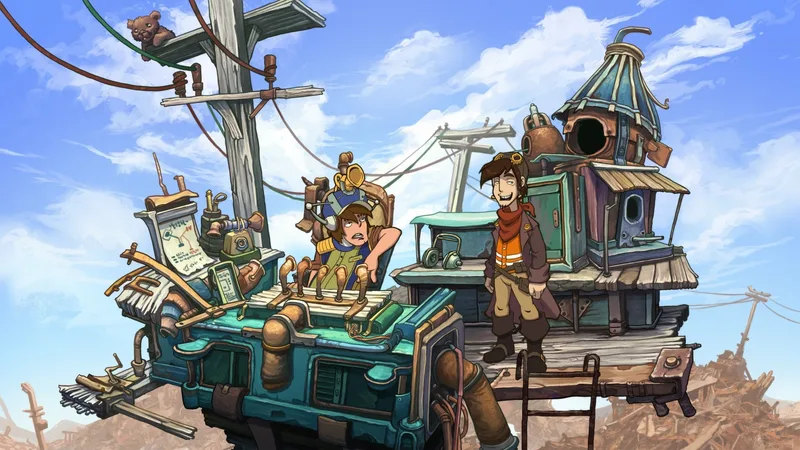
Daedalic's own store description for the first game puts the premise in one line: "the world has degenerated into a vast garbage dump, in which the crotchety Rufus ekes out his sorry existence." That is the whole hook. Deponia is a planet that has been used as a landfill long enough that the rubbish is the terrain — towns are built inside it, people mine it for a living, and nobody alive remembers the surface underneath.
Above it floats Elysium, a city where the people who left live comfortably and have no particular interest in coming back down. The vertical split is not a background detail; it is the engine of the entire series. Rufus wants to get up there, everyone around him has made peace with not getting up there, and four games' worth of plot come out of that gap.
The proportions on this site reflect the proportions in the games. Of the 31 locations catalogued here, 22 sit on the trash surface and only 5 are in Elysium — and Rufus does not reach any of those five until very late. The locations index lays the two levels out as the games present them, with Lower Ascension Station as the single point of contact between them.
What each of the four games covers
Deponia (2012) establishes the world, Kuvaq, and Rufus's first serious attempt to get off the planet. It is the shortest of the four and carries only 19 achievements, most of which track story progress rather than optional discoveries.
Chaos on Deponia (2012) arrived three months later. Daedalic described it as "even wackier than its predecessor," and structurally that is accurate: the game's central complication involves three versions of Goal existing at once, and most of its 34 achievements come from the puzzle chains that complication creates.
Goodbye Deponia (2013) was pitched as "not one, not two, but three Rufuses." It is the longest entry, has 50 achievements, and it closes the trilogy's story. If you are playing the series once, this is the ending the trilogy was built toward.
Deponia Doomsday (2016) came three years after that and is the odd one out. Daedalic's own description asks whether you can "change Rufus' past, present and future," and the game is built around time travel rather than the single forward line the trilogy runs on. It is an epilogue and an alternative rather than a fifth act, which is why the beginner guide recommends treating it as optional on a first run.
Who the story is about
Rufus is the playable character in all four games and the reason most of the plots go wrong. The series is unusually direct about what he is: the character data lists his species as a human clone, and that fact is load-bearing rather than trivia — it is the setup for several of the later complications, including the ones the third and fourth games are built around.
Goal is the other constant. She arrives from Elysium in the first game, and her family connection to Ulysses matters more each time it comes up. Between them, the 77 characters catalogued here split into three named groups the games use as a social structure: 49 Deponians, 16 Elysians, and the Organon, the paramilitary force that polices the surface on Elysium's behalf.
That distribution is itself a joke the series keeps making. The planet has vastly more people on it than the city above, the city has all of the power, and the story is about one Deponian trying to cross a line that almost nobody crosses. The glossary defines the faction names and the terms characters use about each other without giving away the reveals attached to them.
How it ends — spoilers from here
Everything below reveals late-story events, including who dies. If you have not finished the trilogy, stop at this line; nothing further down is needed to play or to look up a puzzle.
The series does not end with everyone getting to Elysium. Of the 56 characters with a recorded status, 11 are dead by the end, one robot is permanently shut down, and one character is erased from existence entirely by the time travel in Doomsday. Rufus himself is among the dead in the original timeline — the character data records the cause as a fall — which is the ending the trilogy commits to and the reason Doomsday had to invent a way around it.
Several of those deaths are played as comedy rather than tragedy, which is consistent with how the series treats almost everything: a robot short-circuits from laughing too hard, another character is eaten by a slime monster, and one is chewed up by a garbage disposal. Two of the Organon characters, Nod and Wink, are shot by Lady Goal. Hermes, the scientist behind the cloning, is cut apart by his own machine. Each character page lists the recorded status and cause where the games establish one, so you can check an individual outcome without reading the rest.
Doomsday's time travel does not undo the trilogy's ending so much as run alongside it. That is why the two are best treated as separate endings rather than one continuous conclusion, and why players who want the story to end where it was designed to end usually stop after Goodbye Deponia.
If you are deciding what to read next
If you have not started, the beginner guide covers play order and which edition to buy. If you are mid-game and stuck, the walkthrough is organised by the flow sections the games actually move through rather than invented chapter numbers. If you want to look someone up without hitting a reveal, character and location pages state what the games establish and keep the late turns on this page instead.